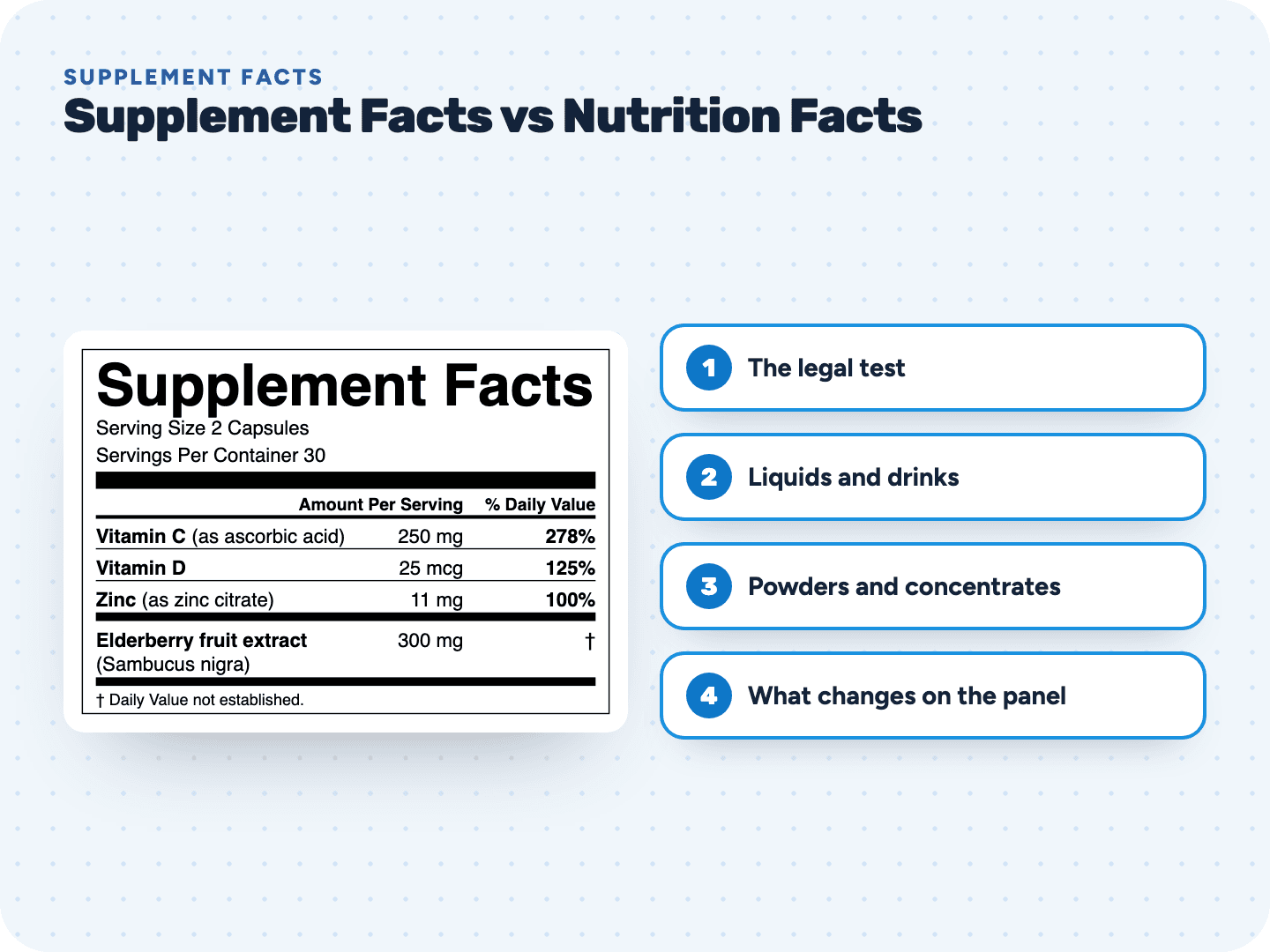
Is it a dietary supplement? The legal test
The FD&C Act defines a dietary supplement in section 201(ff). A product has to tick every box:
Pass all five and the panel must be Supplement Facts. Nutrition Facts rules exempt dietary supplements and send them to the supplement rule instead. Fail one, and calling the product a "supplement" on the label doesn't change what it is.
Liquids: supplement or beverage?
Liquids are where the line blurs, so FDA wrote a guidance on it. Its starting point: beverages are conventional foods and may not be marketed as dietary supplements. The law also says a product counts as "liquid form" only if it is "formulated in a fluid carrier and it is intended for ingestion in daily quantities measured in drops or similar small units of measure."
| Factor FDA weighs | FDA's examples that point to a conventional food | FDA's examples that can point the other way |
|---|---|---|
| Product name | Terms like "beverage", "drink", "water" or "soda", or names like "orange juice" or "iced tea" | A term not used only for beverages, like "tea", is judged together with the other factors |
| Labeling and pictures | Statements that the product will "refresh" or "rehydrate" | |
| Serving size and daily intake | Directions like "Drink up to three 16-ounce bottles per day" | Directions like "one tablespoon three times a day" |
| Packaging | A twelve-ounce pop-top can styled like a soft drink | The labeled serving size and daily intake can outweigh a beverage-like container |
| Marketing | Comparing it with sodas, selling it on taste or refreshment, paying for a spot in the beverage aisle | Promoting a liquid vitamin C as a quicker way to get vitamin C than orange juice |
| Composition | Essentially a copy of a common beverage with a dietary ingredient added |
FDA puts the average daily drinking fluid intake per person at about 1.2 liters (40 fl oz). A label that has people drink all or a significant part of that is effectively presenting the product as a beverage. Adding an herb doesn't change a familiar drink either: FDA's example is ginkgo added to a drink mix or to non-alcoholic eggnog, which doesn't create a ginkgo supplement.
Powders and concentrates you mix with water
A powder or a liquid concentrate that you stir into water can still be a dietary supplement. FDA says it generally won't treat these as beverages when they are labeled as supplements and aren't otherwise presented as drinks or as alternatives to drinks.
- Fine: directions to mix the powder into water for convenience, stability or to mask a taste
- Not fine: a powdered lemonade mix, because lemonade is a beverage
- Not fine: a syrup labeled "Delicious in milk or over ice cream", which presents it for beverage use
What changes on the panel
Once you know which panel you need, these are the differences that most often catch people switching from one to the other:
| Nutrition Facts | Supplement Facts | |
|---|---|---|
| Calories | Always declared | Declared only when the serving has more than an amount that rounds to zero |
| What may appear | Only the nutrients FDA lists as mandatory or voluntary, nothing else | Also herbs, extracts, amino acids and blends, below a heavy bar with a † symbol |
| Nutrient sources | Not in the panel | In parentheses: "Magnesium (as magnesium glycinate)" |
| Vitamins and minerals | Vitamin D, calcium, iron and potassium are required | Only those actually present |
| Protein | Declared | Left off when the product contains only individual amino acids, apart from ingredients added for technical reasons |
| Ingredient list heading | "Ingredients" | "Other ingredients" when sources are named in the panel |
What changes on the rest of the label
| Food | Dietary supplement | |
|---|---|---|
| Product name | The common or usual name of the food | Names the product as a "dietary supplement"; "dietary" may give way to the ingredient, as in "magnesium supplement" |
| Structure/function claims | Allowed if based on nutritive value; no disclaimer, no notice to FDA | Allowed with substantiation, the FDA disclaimer and a notice to FDA within 30 days |
| Major food allergens | Must be declared | Must be declared, in the panel, the ingredient list or a Contains line |
Making either panel in one tool
Our label maker starts with one question: "What are you labeling?" Pick "Food or drink" and you build Nutrition Facts from a recipe, with each ingredient matched to USDA data and the FDA rounding done for you. Pick "Dietary supplement" and you enter your formula per serving: vitamins and minerals with their sources, botanicals, proprietary blends, any calories and macronutrients, and your Other ingredients.
- Same price for both: $29 per label, or a pack or Unlimited plan
- Supplement mode leaves off anything that rounds to zero and tells you what it dropped
- Both modes print a Contains line for the 9 major allergens you mark or we find
- Once a label is paid for, it stays the kind it was paid for. A product that changes category needs a new label