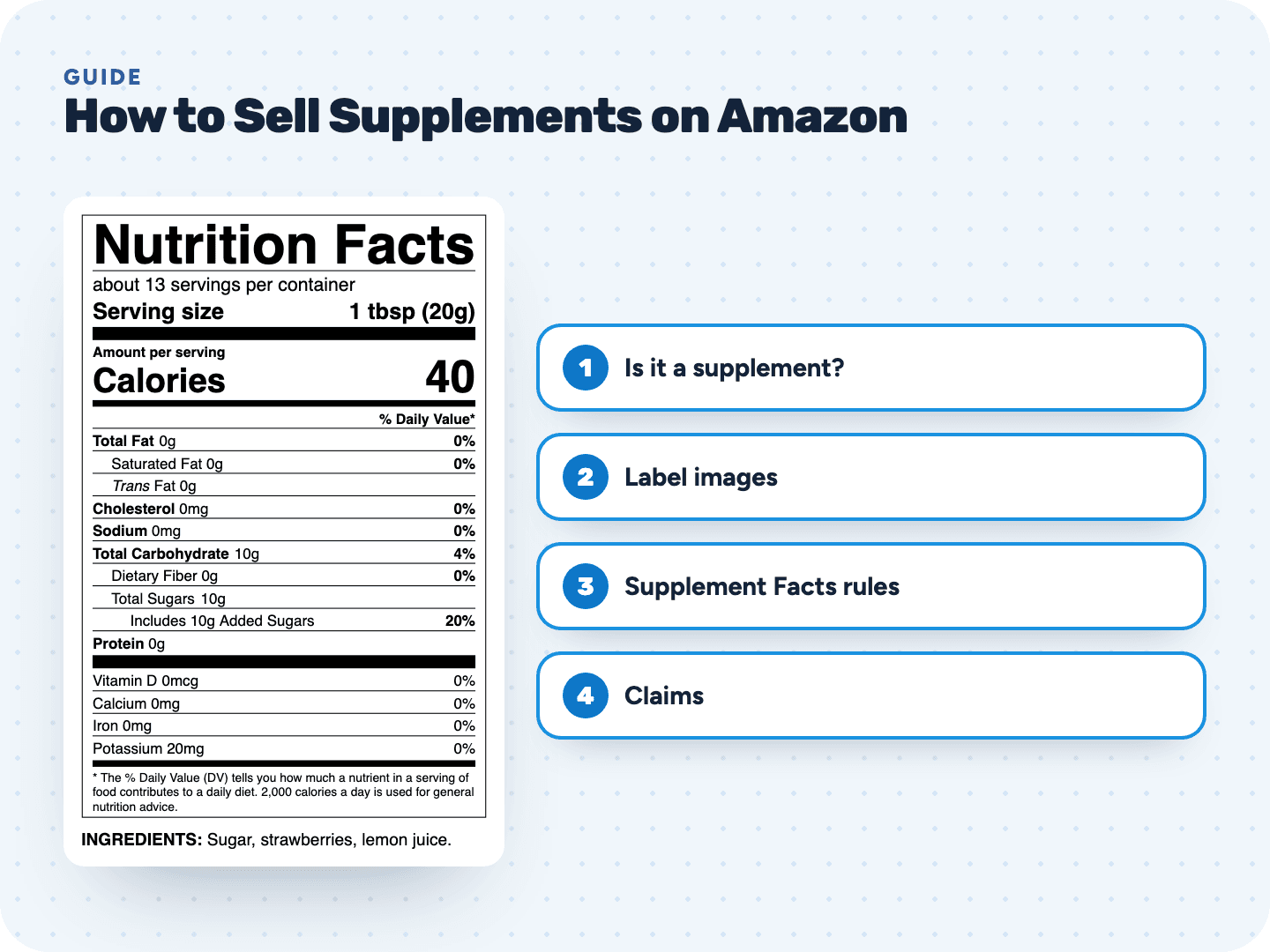
When Amazon treats your product as a supplement
Amazon decides from your listing, label and marketing, not only from what you call the product. Any one of these can put it under the dietary supplements policy:
- A Supplement Facts panel
- A label statement such as "Dietary Supplement" or "Herbal Supplement"
- Claims about vitamins, minerals, herbs, amino acids or botanicals
- Dosing language like "Take 2 capsules daily"
- Health benefit claims and structure or function claims
A product with a Nutrition Facts panel can still fall under the policy if the listing does any of the above. A protein powder sold with dosing directions and "supports recovery" in the bullets is a typical case.
The label images and listing details Amazon requires
The product detail page needs the item name with the name of the supplement, the manufacturer, the brand, the ingredients list and the unit count, like 100 tablets. The images must show the full English label on the product, including:
- The name of the supplement and the total quantity
- The Supplement Facts (or Nutrition Facts) panel and any continued panels
- The ingredients list, certification logos, instructions for use and warnings
- Identifying codes such as lot or serial numbers
- The name and address of the brand owner, manufacturer, packer or distributor
No FDA logo anywhere on the images. And the photos have to show the same product that was tested, so print the final label before the TIC provider sees your bottle.
Get the Supplement Facts panel right first
Amazon requires compliance with 21 CFR 101, and for supplements the core of that is 21 CFR 101.36. A few rules reviewers look at first:
- The title "Supplement Facts" is bold, larger than all other print in the panel, and full width unless impractical
- The serving size uses a term that fits the form: "tablets", "capsules", "packets" or "teaspoonfuls"
- Dietary ingredients without a Daily Value still list an amount per serving, marked with a symbol and the footnote "Daily Value not established"
- Other ingredients, like the capsule shell and fillers, are listed in an ingredient statement placed just under the panel, or beside it when space is short
Our Supplement Facts mode builds this panel for you: vitamins and minerals with their source, botanicals with the plant part, proprietary blends with their total weight, and the Other ingredients line. You get a vector PDF for printing and a 600 dpi PNG for your listing images, so the bottle and the product page match.
Supplement Facts Label Maker →Supplement Facts Label Requirements →Claims that get supplement listings pulled
Listings and images may not:
- Show the FDA logo, or claim "FDA approved" without official FDA approval
- Make disease claims, or put disease names in your keywords
- Compare the product to a prescription drug or controlled substance, including look-alike names such as "GLP-1"
- Promise steroid-like effects, as in "Legal Steroids"
- Say "tester" or "not for retail sale" on the label
- Claim a non-GMO status without the documentation Amazon lists
Watch your milligram numbers. Amazon rejects weight claims that don't match the Supplement Facts panel, such as turning a 500 mg extract into "10,000 mg" of raw herb, or quoting a weight without the ingredient name or the portion it refers to.
FDA's own rule for structure or function claims applies on top: the label carries the standard disclaimer, and you notify FDA within 30 days of first selling the product with that claim. Our tool does not write or check claims.
cGMP certificates, testing and the TIC provider
This is the step that surprises new brands. You don't upload compliance documents to Amazon yourself. An Amazon-authorized TIC provider reviews or creates them and submits them for every notified product. You can test at another accredited lab, but an authorized TIC provider then validates the results.
| What | Applies to | Amazon's rule |
|---|---|---|
| cGMP certificate | All dietary supplements | Made under 21 CFR 111 or 21 CFR 117 (or equivalent), audited or certified by an accredited third party. Private, first-party and consulting audits and FDA inspections are not accepted |
| Lab testing | Bodybuilding, joint health, sexual enhancement, sports nutrition, weight management | Heavy metals and microbes, pesticides where relevant, known adulterants, and dietary ingredient amounts within FDA tolerances |
| Insurance | Dietary supplements | A Certificate of Insurance through Business Insurance verification in Seller Central |
A current GFSI food safety certification at your manufacturer may satisfy the cGMP requirement. Ask your contract manufacturer for its certificate early: Amazon accepts only a certificate in good standing, never an expired one.
The tolerance test is where the label and the lab meet. Under FDA's rules, a vitamin or mineral you add must be present at no less than 100% of the amount on the label, and a naturally occurring one at no less than 80%. Declare what you can actually deliver through the end of shelf life.
Supplements Amazon won't list
- Products named in an FDA recall, safety alert or warning letter
- CBD and anything else on the Controlled Substances Act schedules
- Peptides such as BPC-157, and GLP-1 receptor agonists
- Products with pure powdered caffeine
- Skin patches marketed as dietary supplements or detox products
- Sexual enhancement and weight loss supplements in single- or double-pill packs
What FDA requires before you sell
FDA doesn't approve supplements before they go on sale. The responsibility sits with your company: the product must be safe, the claims truthful, and the label must follow the rules. That is exactly why Amazon asks for third-party proof.