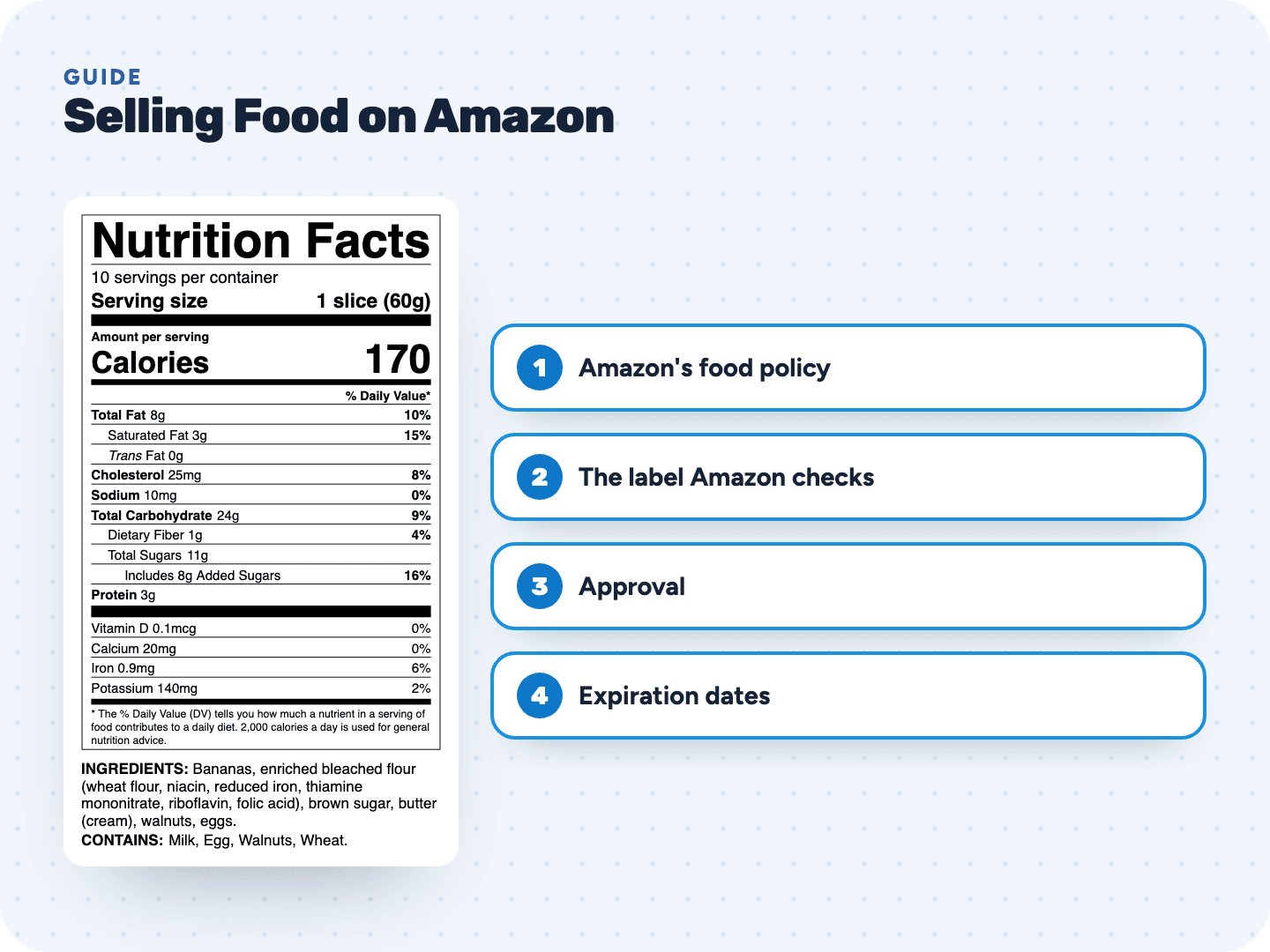
Amazon's food policy in one paragraph
Amazon's Grocery & Gourmet Food page adds the business side. In short:
- Food must be properly prepared, packaged, sealed and labeled
- You must be licensed, or have approval from the relevant government agency, for the products you sell
- Your products and business must follow federal and state laws, including laws Amazon's policies don't describe
- Everything is sold new. No used grocery products
- Labels are in English, following FDA's food labeling rules (or USDA's for products it regulates)
- Packaging must suit shipping and keep food from contamination, spoiling, melting and damage
Nutrition Label Studio is not affiliated with Amazon. We quote its published Seller Central help pages, which Amazon can change at any time, so read the current version before you list.
The label Amazon wants to see
Amazon's food policy lists what an FDA and USDA compliant label must show, in English. Each item maps to a federal rule:
| Amazon asks for | Federal rule | Who makes it |
|---|---|---|
| Statement of identity, distinct from the brand name | 21 CFR 101.3 | Your package artwork |
| Net quantity in weight, measure or count | 21 CFR 101.7 | Your package artwork |
| Name and address, with "manufactured for" or "distributed by" if you don't make it | 21 CFR 101.5 | Your package artwork |
| Ingredients from most to least by weight | 21 CFR 101.4 | Our tool |
| Allergen declaration | 21 U.S.C. 343(w) | Our tool |
| Nutrition Facts panel | 21 CFR 101.9 | Our tool |
Our tool builds the regulated part from your recipe: the Nutrition Facts panel with FDA rounding, the ingredient statement from heaviest to lightest with each compound ingredient broken down, and a Contains statement with the exact nut, fish or shellfish species, like pecans or shrimp. Export it as a vector PDF for your designer or printer, and as a 600 dpi PNG to check against your listing photos.
Start your label free →Do you need approval to sell food on Amazon?
It depends on the product, the brand and your account, and Amazon shows you which applies. Search for the product in Add Products and read the status:
| Status in Seller Central | What it means |
|---|---|
| Sell this product | No approval needed |
| Apply to sell | Approval required |
| Not Available | The product can't be listed |
For an application, Amazon lists purchase invoices dated within 180 days, clear photos of all sides of the product, brand authorization letters if they apply, safety certifications when required, and insurance documents for certain categories. It gives 2 to 7 business days for the review.
Grocery sellers also have performance targets to hit:
- Order defect rate under 1%
- Pre-fulfillment cancel rate under 2.5%
- Late shipment rate under 4%
Expiration dates and shelf life
Amazon treats food as date-sensitive. Every unit you ship, and every unit shown for sale, carries a permanently marked expiration date unless the product is exempt.
- Amazon counts "sell by", "use by", "best by", "best before" and "best if used by" as expiration dates
- Ship with enough shelf life left, and never remove or change the date
- A multi-pack shows the earliest date of the products inside
- The food and beverage policy asks for a shelf life of more than 90 days
That 90-day line rules out a lot of fresh bakery and deli food. Dry, shelf-stable products such as granola, candy and spice blends are the easier fit, as long as your own shelf-life testing backs up the date you print.
Food Date Labeling →Claims Amazon blocks
Your listing, images, packaging and inserts may not:
- Show the FDA logo
- Say "FDA approved"
- Claim the food diagnoses, cures, mitigates, treats or prevents disease
- Say "organic" or use the USDA organic seal without valid USDA organic certification, or without naming the certifier on the listing
- Make health, therapeutic or purity claims without evidence from certified testing
Amazon's grocery page adds that dietary and allergen-free claims such as Organic, Kosher, Gluten-Free and Dairy-Free must be on the product label and backed by the right regulatory approvals. Our tool flags the major allergens in your recipe, but it does not check claims like "gluten-free". Check those against the rule before they go on the package.
FDA Gluten-Free Label Requirements →Organic Food Label Requirements (USDA) →Chilled and frozen food
Refrigerated and frozen food goes in packaging that keeps it at a safe temperature all the way to the door, and you must be able to prove it. Amazon asks you to validate the chill chain in worst-case conditions with an independent lab, verify it in real deliveries, and keep the records for Amazon and regulators.
| Food type | Conforming temperature |
|---|---|
| Refrigerated processed foods | 32-41° F |
| Refrigerated processed dairy or liquid eggs | 32-41° F |
| Frozen foods | < 10° F |
Can you sell homemade food on Amazon?
Not in practice. Amazon asks for a license or approval from the relevant government agency, and cottage food laws are built for small, local sales. Most of them only cover customers in your own state, and Amazon sells to buyers across the country.
The usual path is to move production to a licensed commercial kitchen or a co-packer. That kitchen registers with FDA unless it is exempt, and the label switches to the full federal format, Nutrition Facts included. The recipe you already have is the starting point for that label.
How to Sell Food Online →Co-Packer →Food Amazon won't list
Some foods are off the table no matter how good the label is. Amazon's examples include:
- Alcoholic beverages and food products with more than 0.5% alcohol by volume
- Mad honey (deli bal, grayanotoxin honey)
- Imported food items with embedded toys, which Amazon lists as ineligible for US import
- Betel nuts and products with betel nut flavoring
- Sodium nitrite in a concentration greater than 10%