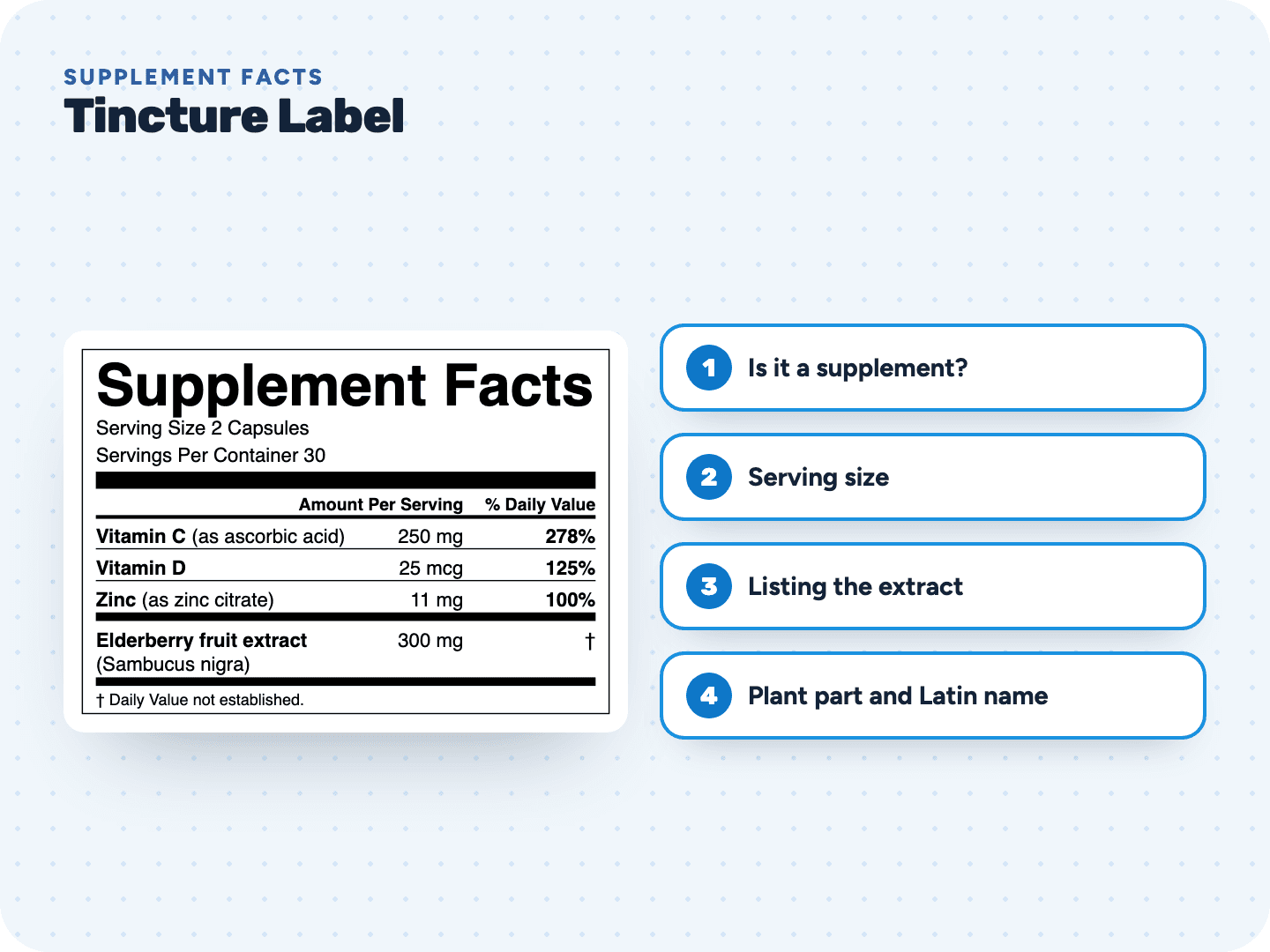
When a tincture is a dietary supplement
Federal law counts an herb or other botanical, and an extract of one, as a dietary ingredient. A liquid is an allowed form. The product becomes a dietary supplement when it is meant to supplement the diet, is labeled as a dietary supplement and is not represented as a conventional food.
- The name includes "dietary supplement", or swaps "dietary" for the ingredient or type: "Echinacea supplement", "Herbal supplement"
- Supplement Facts sits on the label, not Nutrition Facts
- Directions give a dose, like 1 dropper in water
CBD tinctures are a different story. FDA's answer to whether THC or CBD products can be sold as dietary supplements:
Serving size: droppers and teaspoons
FDA's reference amount table gives dietary supplements no fixed amount. The serving is:
Say it in a unit that fits the form. Our Supplement Facts mode has a Dropper unit, which prints as 1 Dropper, and Teaspoon and Tablespoon units that can show the weight too, like 1 Teaspoon (5 g). Servings per container follows from your bottle: 30 mL of tincture and a 1 mL dropper make 30 servings.
How to list a liquid extract
A tincture is a liquid extract with the solvent still in it. FDA spells out how that goes on the panel:
| Part of the line | Example | Required? |
|---|---|---|
| Amount of the whole extract per serving | 930 mg, or the volume in mL | Yes |
| Fresh starting material | "Fresh echinacea root extract" | Yes, when the herb was fresh; optional for dried |
| Concentration | "1:2", herb weight to solvent volume | Optional |
| Solvent | "in 50% alcohol" | Optional in the panel; then it must be in the ingredient list |
Our tool takes the amount by weight, in mg or g, which the rule allows. Weigh 10 full droppers of your tincture and divide by 10. When the solvent has been removed completely, as in a dried extract, list the weight of the dried extract instead.
The plant part and the Latin name
- Name the part of the plant in English, like "root" or "leaf": "flower", not "flos"
- Add the Latin binomial in parentheses, like "(Echinacea purpurea)", unless your common name is in Herbs of Commerce, the botanical name reference FDA uses
- Algae are the one group that skips the plant part
Example: fresh echinacea root tincture
A 30 mL dropper bottle, 1 mL per dropper, and one full dropper weighs 930 mg in this example. This is the panel our Supplement Facts mode builds from it:
| Supplement Facts | Amount Per Serving | % Daily Value |
|---|---|---|
| Serving Size 1 Dropper | ||
| Servings Per Container 30 | ||
| Fresh echinacea root extract (Echinacea purpurea, 1:2 in 50% alcohol) | 930 mg | † |
| † Daily Value not established. |
- Calories under 5 per serving round to zero, and a Supplement Facts panel leaves zero amounts off. Enter your calories and the tool drops them when they round away
- No vitamins or minerals, so no % Daily Value numbers: the herb gets a † and the footnote
- The solvent is named in the panel, so the ingredient list may leave it out
Alcohol and other ingredients below the panel
Right under the panel comes the ingredient list. It starts with "Other ingredients" when sources are already named inside the panel, and "Ingredients" otherwise. Flavors, sweeteners, preservatives and anything else that is not a dietary ingredient belong there. A solvent you leave out of the panel goes there too, by its common name.
Structure/function claims and the disclaimer
Say what the herb does for a body structure or function, and FDA requires this exact wording beside the claim, or tied to it by a symbol, set in bold letters no smaller than 1/16 inch:
- Tell FDA about the statement no later than 30 days after you first market the tincture
- Promise to cure, treat or prevent a disease and the tincture is regulated as a drug, unless the wording is an authorized health claim it qualifies for
- Our tool builds the panel; it does not check your claims