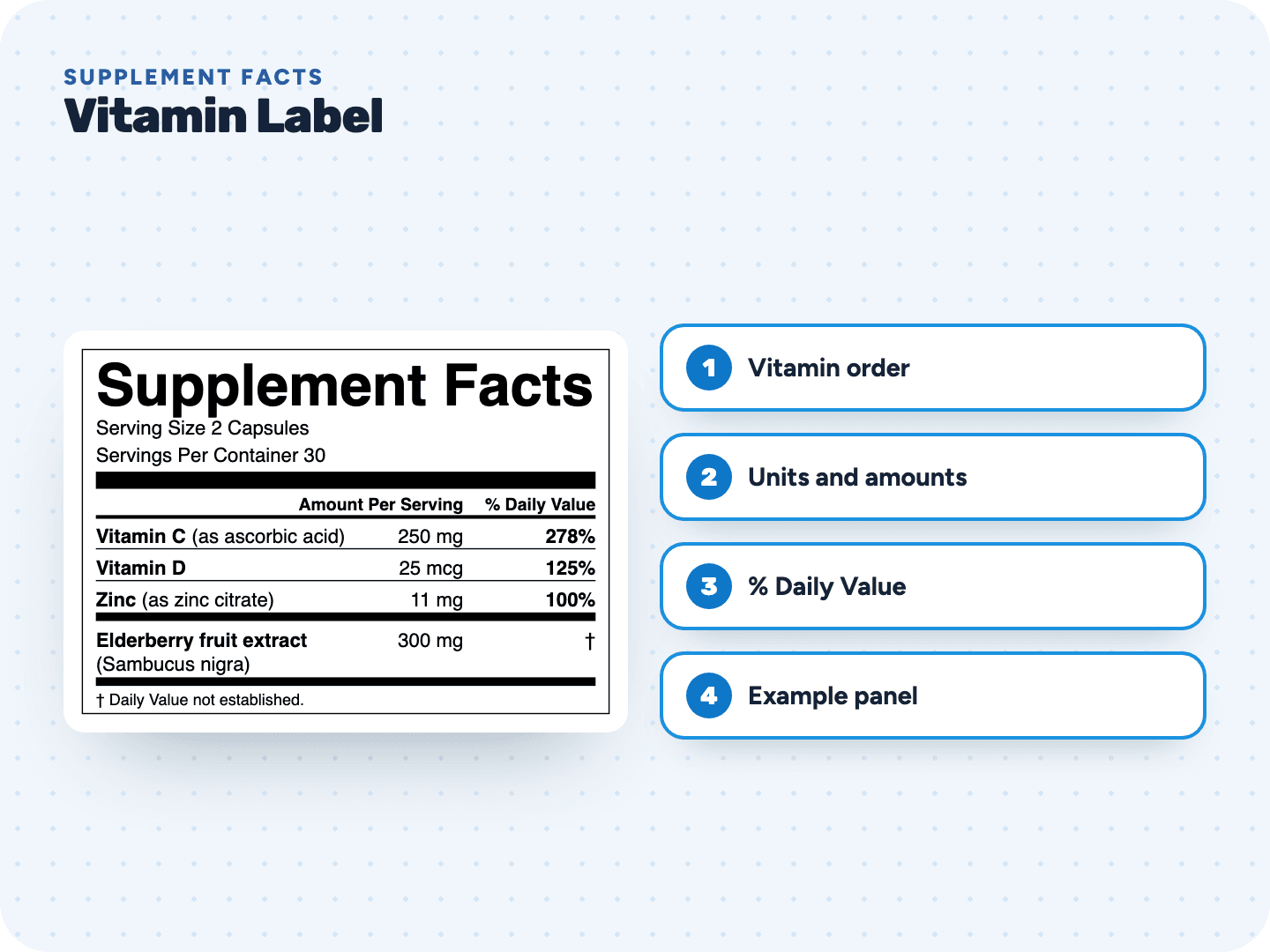
The order vitamins and minerals go in
You don't pick the order on a Supplement Facts panel. Calories and the macronutrients come first when present, then the vitamins and minerals in this sequence:
Calcium and iron sit after choline here, not near the top as on Nutrition Facts, and sodium and potassium follow chloride. Our tool sorts every vitamin and mineral into this order for you, whatever order you type them in.
Units: the nutrient, not the compound
- The amount is the weight of the vitamin or mineral itself: 8 mg of zinc, not the weight of the zinc citrate
- Each nutrient uses the unit of its Daily Value: mcg for vitamin D, B12 and iodine, mg for zinc and vitamin C
- Amounts follow the decimal places of the Daily Value, with extra decimals only when a small amount would otherwise show as zero
- Vitamin D is declared in mcg; IU may follow in parentheses, like 25 mcg (1,000 IU)
| Nutrient | Daily Value, adults and children 4+ | Unit |
|---|---|---|
| Vitamin D | 20 | mcg |
| Vitamin B12 | 2.4 | mcg |
| Iodine | 150 | mcg |
| Zinc | 11 | mg |
| Vitamin C | 90 | mg |
| Iron | 18 | mg |
% Daily Value and the 2% cutoff
- %DV is the amount divided by the Daily Value, rounded to the nearest whole percent
- An amount above the Daily Value gives a percentage above 100%: 250 mcg of vitamin B12 prints as 10,417%
- A vitamin or mineral under 2% of its Daily Value counts as zero and is left off the panel
- Nothing is listed at zero, the opposite of Nutrition Facts
Example: a daily vitamin capsule
One capsule a day, 60 capsules in the bottle. Typed into our Supplement Facts mode, the formula comes out like this:
| Supplement Facts | Amount Per Serving | % Daily Value |
|---|---|---|
| Serving Size 1 Capsule | ||
| Servings Per Container 60 | ||
| Vitamin D (as cholecalciferol) | 25 mcg (1,000 IU) | 125% |
| Vitamin B12 (as methylcobalamin) | 250 mcg | 10,417% |
| Iodine (as potassium iodide) | 150 mcg | 100% |
| Zinc (as zinc citrate) | 8 mg | 73% |
Below the panel: Other ingredients: hypromellose (capsule), rice flour. The sources are named inside the panel, so the list starts with "Other ingredients" and they don't appear twice.
Naming the source
The source may sit in parentheses after the nutrient, starting with "as" or "from": "Vitamin D (as cholecalciferol)". Two sources for one nutrient? List both inside the parentheses, heaviest first. When the nutrient's name or synonym is itself the source, like ascorbic acid for vitamin C, the parentheses are not needed.
If you leave the sources out of the panel, they must appear in the ingredient list under the panel, which then starts with "Ingredients".
The iron warning
A tablet, capsule or other solid oral form with iron as an iron source carries this warning on the information panel, set off in a box with hairlines:
When the bottle sits in a carton, the warning goes on the carton's information panel as well. The warning is not part of the Supplement Facts panel, so place it in your artwork next to our panel.
Vitamins for children or pregnancy
A vitamin made for infants, children 1 through 3, or pregnant or lactating women uses the Daily Values for that group, and the column heading has to say which group it is. Iodine shows why it matters: 150 mcg for adults, 290 mcg for pregnant and lactating women.
Our tool calculates % Daily Value for adults and children 4 years and older. It does not make columns for infants, children 1 through 3, or pregnant or lactating women.
Claims on a vitamin bottle
A statement about how a vitamin affects the structure or function of the body needs FDA's disclaimer in bold next to it, and FDA must hear about it within 30 days of first marketing. Claims about a classic deficiency disease, like scurvy, are treated differently from claims about other diseases, which make the bottle a drug. Our tool does not check claims.