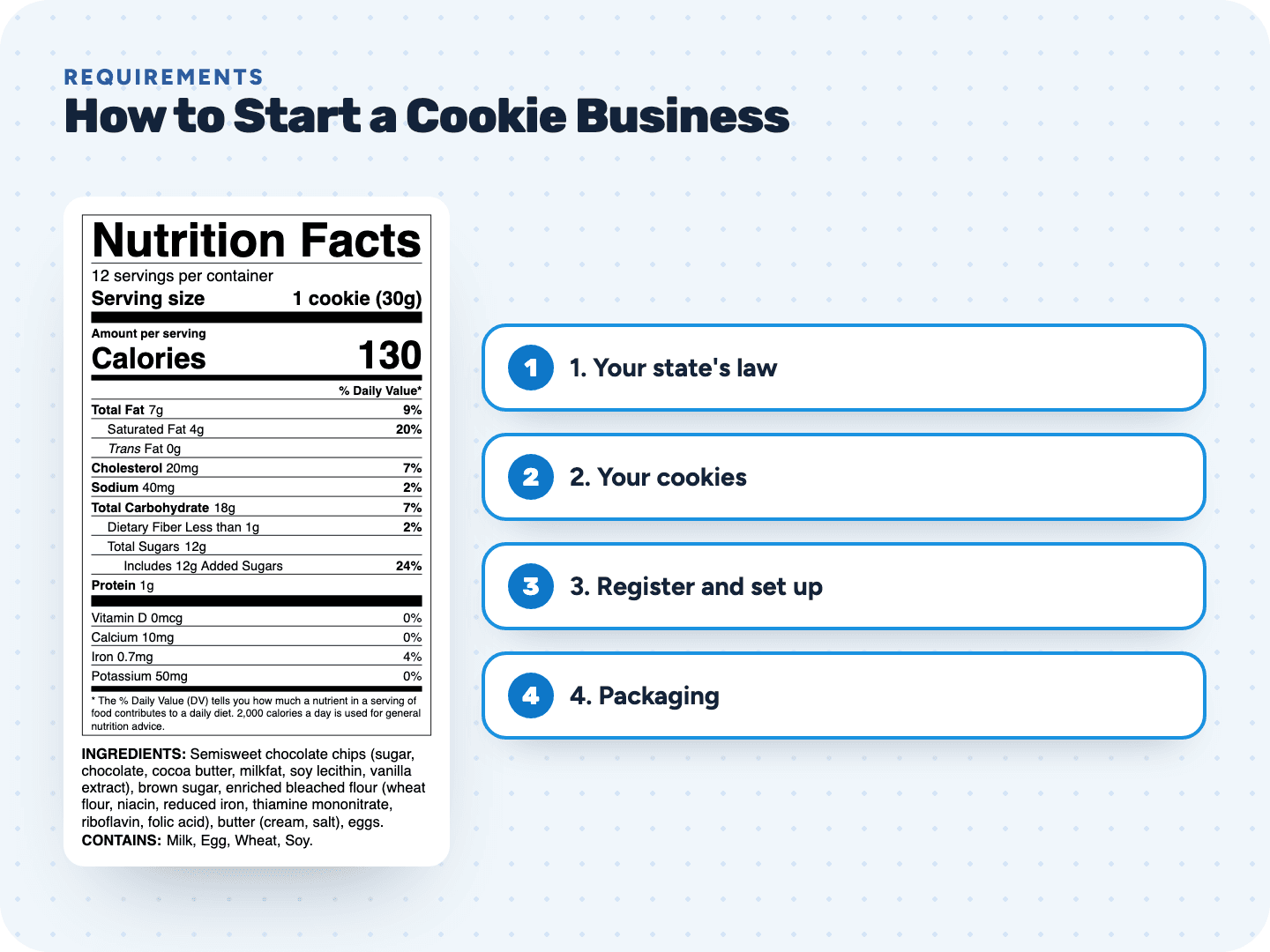
Step 1: Check what your state asks before you sell cookies
Selling cookies from home is a state matter. Some states let you start baking for customers tomorrow, others want a registration, a course or a permit first. Six states show the range:
| State | Before your first sale | Yearly sales cap | Online and shipping |
|---|---|---|---|
| Michigan | Nothing to file | $50,000, or $75,000 if items sell for $250 or more | Online and mail order inside Michigan |
| Oregon | Food handler card | $52,700 | Online and by mail allowed |
| Arizona | Free ADHS registration and a food handler card | None | Inside Arizona only |
| Maryland | Nothing for direct sales; an MDH review before selling to stores | $100,000 | Mail inside Maryland |
| Illinois | Yearly local registration (fee up to $50) and a food protection manager credential | None | Shipping inside Illinois, tamper-evident seal |
| Nevada | Registration with your local health authority | $100,000 | Face to face only, no shipping |
Write down three things from your own state's page: what you file, the training, and where the money stops. Those decide how fast you can open and how big the business can get at home.
Step 2: Pick your cookies and lock in the recipes
Start with three to five cookies you can bake the same way every time. A consistent recipe gives you a consistent cookie, a fixed cost and one label you print again and again. Every change to a recipe can change the ingredient list and the allergens, so treat a new flavor as a new product.
Check the risky extras against your state's list before you put them on the menu:
- Cream cheese fillings and frostings are out in many states
- Buttercream depends on the state; Connecticut accepts frosting made only from shelf-stable ingredients such as shortening, sugar and meringue powder
- Fresh fruit on top is excluded in Missouri and Georgia
- Cheesecake bars need refrigeration, so they usually fall outside cottage food
Plain drop cookies and shortbread are the simplest place to start. Decorated sugar cookies work too, as long as the icing passes your state's rules.
Step 3: Register, train and set up your kitchen
Do the paperwork your state asks for, take the course, then set up your kitchen the way the inspectors expect, even if nobody comes to check:
- Store ingredients and finished cookies inside your home; Michigan rules out the garage, shed or barn
- Keep pets out of the kitchen while you bake for sale; Oregon allows pets in the house on that condition
- Keep young children out while you work; Kentucky names children under 12
- Test your well water if you have one; several states ask for a yearly test
- Ask your city or county about home business rules and zoning
Step 4: Package your cookies
Many cottage food laws want your cookies packaged and labeled before they leave the house. Pick packaging that seals well and leaves room for a label:
- Cello bags or boxes of a fixed count, like six or twelve cookies, so one label fits every package
- Single wrapped cookies for markets and coffee counters, each with its own label
- A tamper-evident seal: Arizona requires one, and lets the label itself serve as the seal
- No vacuum sealing in Ohio, where reduced oxygen packaging is banned for cottage food
Weigh a few finished packages. Kentucky, for example, accepts a numerical count like 12 cookies, but several states want the net weight in both US and metric units.
Step 5: Label every bag
Your label carries the cookie's name, your name and address, the ingredients by weight, the allergens, the net weight and, word for word, your state's home kitchen statement. Nutrition Facts are optional for most small home bakers, until you print a claim such as "sugar free". Here is what our tool prints for a batch of oatmeal raisin cookies:
- Recipe: 1 cup unsalted butter, 1 cup brown sugar, 1/2 cup sugar, 2 eggs, 1 tsp vanilla extract, 1 1/2 cups all-purpose flour, 1 tsp baking soda, 1 tsp cinnamon, 1/2 tsp salt, 3 cups rolled oats, 1 cup raisins
- Baked weight: 38.1 oz, or 36 cookies of 30 g, sold in bags of six
- Serving: 1 cookie (30g), because FDA's reference amount for cookies is 30 g
Ingredients: Rolled oats, butter (cream), brown sugar, enriched bleached flour (wheat flour, niacin, reduced iron, thiamine mononitrate, riboflavin, folic acid), raisins, sugar, eggs, baking soda, vanilla extract (vanilla bean extractives in water, alcohol), salt, cinnamon. Contains: Milk, Egg, Wheat.
Oats lead the list because 3 cups of oats outweigh every other ingredient. Butter brings milk, so the Contains line names Milk even though the word milk never appears in the recipe.
Step 6: Price your cookies
Work out the cost of one cookie: the ingredients of a batch divided by the cookies it yields. Add the bag, the sticker and your time, then set a price per bag and per single cookie. Check the math again when butter or chocolate prices move.
Labels are a one-time cost per recipe. With us a label is $29, or $69 for three recipes and $199 for ten, and you print it as often as you like. The preview is free, so you can see the finished label before you pay.
Label pricing →Step 7: How to sell cookies from home
Most cookie businesses mix two or three of these channels. Each one depends on your state's rules:
- Pre-orders picked up at your home: simple, and allowed almost everywhere
- Farmers markets and craft fairs: bring labeled packages; unwrapped cookies on a tray can need an extra license
- Holiday and party orders: gift boxes and cookie platters sell by the dozen
- Online orders: allowed in many states, with delivery or shipping limited to customers in your state
- Coffee shops and stores: only where your state allows sales for resale, like Ohio and Georgia
When your cookie business outgrows your kitchen
A sales cap, a grocery store that wants your cookies, or customers in other states will sooner or later send you to a licensed kitchen or a co-packer. At that point the home kitchen statement comes off, and a Nutrition Facts panel usually comes in. Because your recipes are already in our tool, the panel is already calculated.
Co-Packer →Cookie Label Template →Cottage food laws for cookie businesses, by state
- Alabama
- Alaska
- Arizona
- Arkansas
- California
- Colorado
- Connecticut
- Delaware
- Florida
- Georgia
- Hawaii
- Idaho
- Illinois
- Indiana
- Iowa
- Kentucky
- Louisiana
- Maine
- Maryland
- Massachusetts
- Michigan
- Minnesota
- Mississippi
- Missouri
- Nebraska
- Nevada
- New Jersey
- New Mexico
- New York
- North Carolina
- Ohio
- Oklahoma
- Oregon
- Pennsylvania
- South Carolina
- South Dakota
- Tennessee
- Texas
- Utah
- Virginia
- Washington
- West Virginia
- Wisconsin