Four states, four answers on selling baked goods online
Taking the order online is rarely the problem. The delivery is. Here is how four states handle a batch of cookies sold through a website:
| State | Orders online | Mail or shipping | Buyers in other states |
|---|---|---|---|
| Virginia | Yes | Yes, to individuals in Virginia | No |
| Michigan | Yes, when the buyer can reach you before buying | Yes, inside Michigan | No |
| Connecticut | Yes | No: no mail, UPS, FedEx or delivery apps | No |
| Washington | Orders yes, payment and handover in person | No: no mail or courier | No |
Connecticut's Department of Consumer Protection puts it in plain words: advertise and take orders online, then deliver the product directly to the consumer within the state, person to person.
Washington's WSDA page is less tidy. One answer says you can take orders over the Internet, while another lists Internet sales among the things that are prohibited. Read together, the order may come in online, but payment and delivery happen face to face. If you plan a web shop in Washington, ask WSDA to confirm your setup first.
Virginia Cottage Food Law →Michigan Cottage Food Law →Connecticut Cottage Food Law →Washington Cottage Food Law →Why your home bakery stops at the state line
A cottage food law is a state exemption from that state's own food licensing rules. It can't exempt you from another state's rules, or from federal law. Once a box of brownies crosses into another state, it is in interstate commerce, which FDA regulates, and your home kitchen exemption doesn't travel with it.
So a bakery that wants customers nationwide moves into a licensed kitchen. From there:
- Your state licenses the kitchen as a food manufacturer or processor
- The kitchen registers with FDA as a food facility, unless an exemption applies
- The label follows the full federal rules, usually with a Nutrition Facts panel
The label on baked goods you sell online
Every package that leaves your kitchen carries your state's cottage food label, whether you hand it over at the door or drop it in the mail. Put the label on each bag or box the customer opens, not only on the shipping carton.
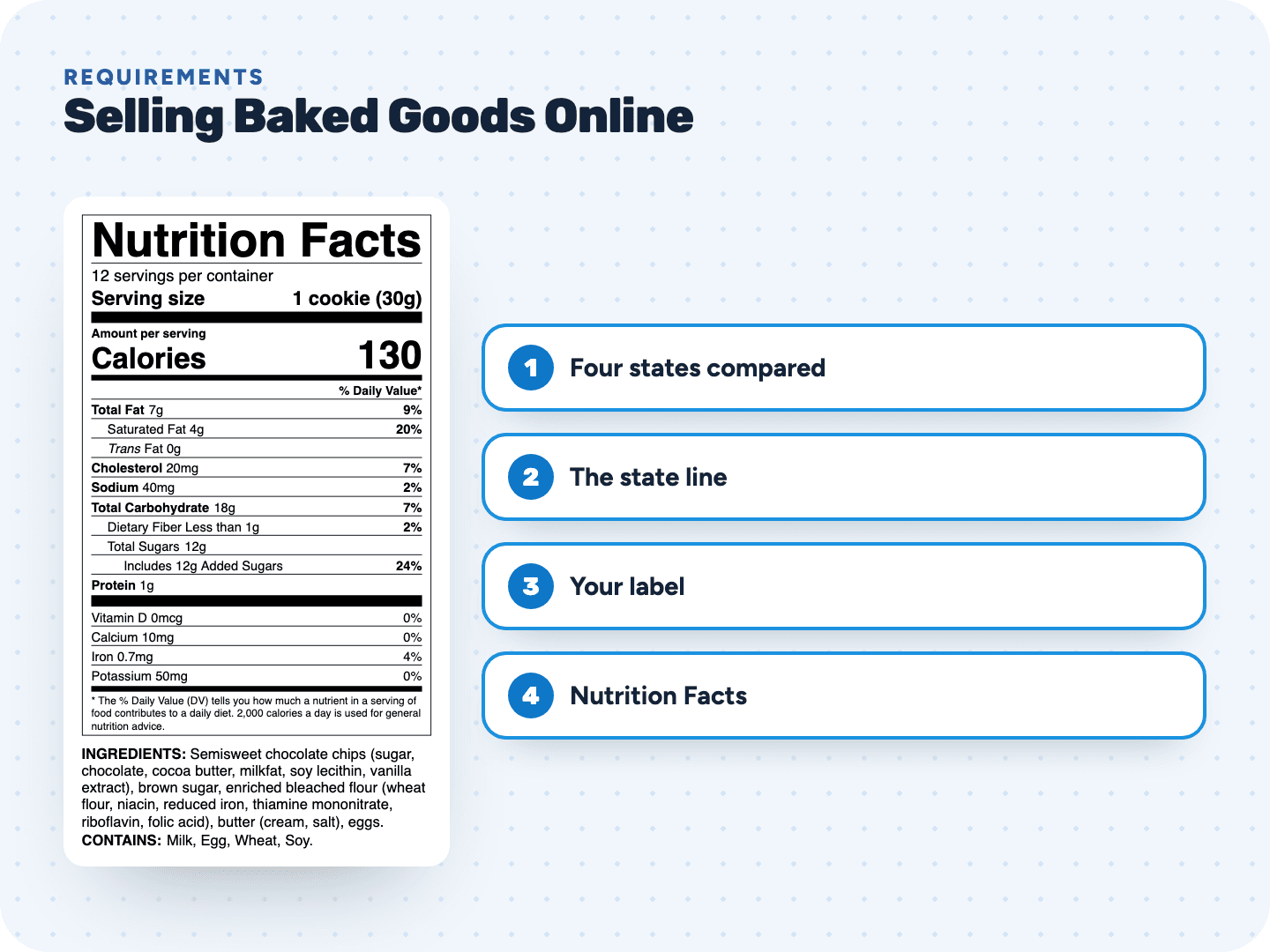
Here is a soft molasses pecan cookie, run through our tool with only USDA-matched ingredients. FDA's reference amount for cookies is 30 g (21 CFR 101.12, Table 2). Our cookie weighs 32 g, which falls between 67% and 200% of that amount, so the serving is one whole cookie. A 9 oz (256 g) bag holds 8 servings.
| Label part | What the tool printed |
|---|---|
| Ingredients | Enriched bleached flour (wheat flour, niacin, reduced iron, thiamine mononitrate, riboflavin, folic acid), brown sugar, butter (cream), pecans, molasses, eggs, baking soda, ginger, cinnamon, salt |
| Allergens | Contains: Milk, Egg, Pecans, Wheat. |
| Serving size | 1 cookie (32g) |
| Calories per serving | 140 |
Two details people get wrong by hand: the flour lists what is in it, from niacin to folic acid, and the allergen line says pecans instead of a vague "tree nuts".
Do baked goods sold online need Nutrition Facts?
Most cottage food labels skip the Nutrition Facts panel unless you make a nutrition claim. Florida's statute shows how that works: its cottage food label lists the basics, and adds nutrition information only when you claim something.
Online, claims slip in easily: "low sugar" in a product title, "protein cookie" in a description. If a claim is part of your pitch, add the panel. Once you move to a licensed kitchen and ship nationwide, Nutrition Facts are the norm unless you qualify for a federal exemption.
Baked Goods Labeling Requirements →Packing baked goods you mail
Where your state allows mail delivery, a few habits keep the order safe and legal:
- Mail only foods your cottage food law allows, and only shelf-stable items that need no refrigeration
- Seal each item in its own labeled package before it goes in the box
- Check the buyer's address is in your state before you print the shipping label
- Keep a copy of each label version with your sales records
Etsy, Facebook and Amazon
A marketplace doesn't change your state's rules. Your own website gives you the most control, and on Etsy or Facebook Marketplace you still follow the cottage food law plus the platform's food policy. Amazon is a different story: it wants sellers licensed or approved by the relevant agency, and its food policy sets a minimum shelf life of over 90 days. Most fresh home baking fails both.
Can You Sell Food on Etsy? →Can You Sell Food on Facebook Marketplace? →Selling Food on Amazon →Selling baked goods online: checklist
Cottage food laws by state
- Alabama
- Alaska
- Arizona
- Arkansas
- California
- Colorado
- Connecticut
- Delaware
- Florida
- Georgia
- Hawaii
- Idaho
- Illinois
- Indiana
- Iowa
- Kentucky
- Louisiana
- Maine
- Maryland
- Massachusetts
- Michigan
- Minnesota
- Mississippi
- Missouri
- Nebraska
- Nevada
- New Jersey
- New Mexico
- New York
- North Carolina
- Ohio
- Oklahoma
- Oregon
- Pennsylvania
- South Carolina
- South Dakota
- Tennessee
- Texas
- Utah
- Virginia
- Washington
- West Virginia
- Wisconsin