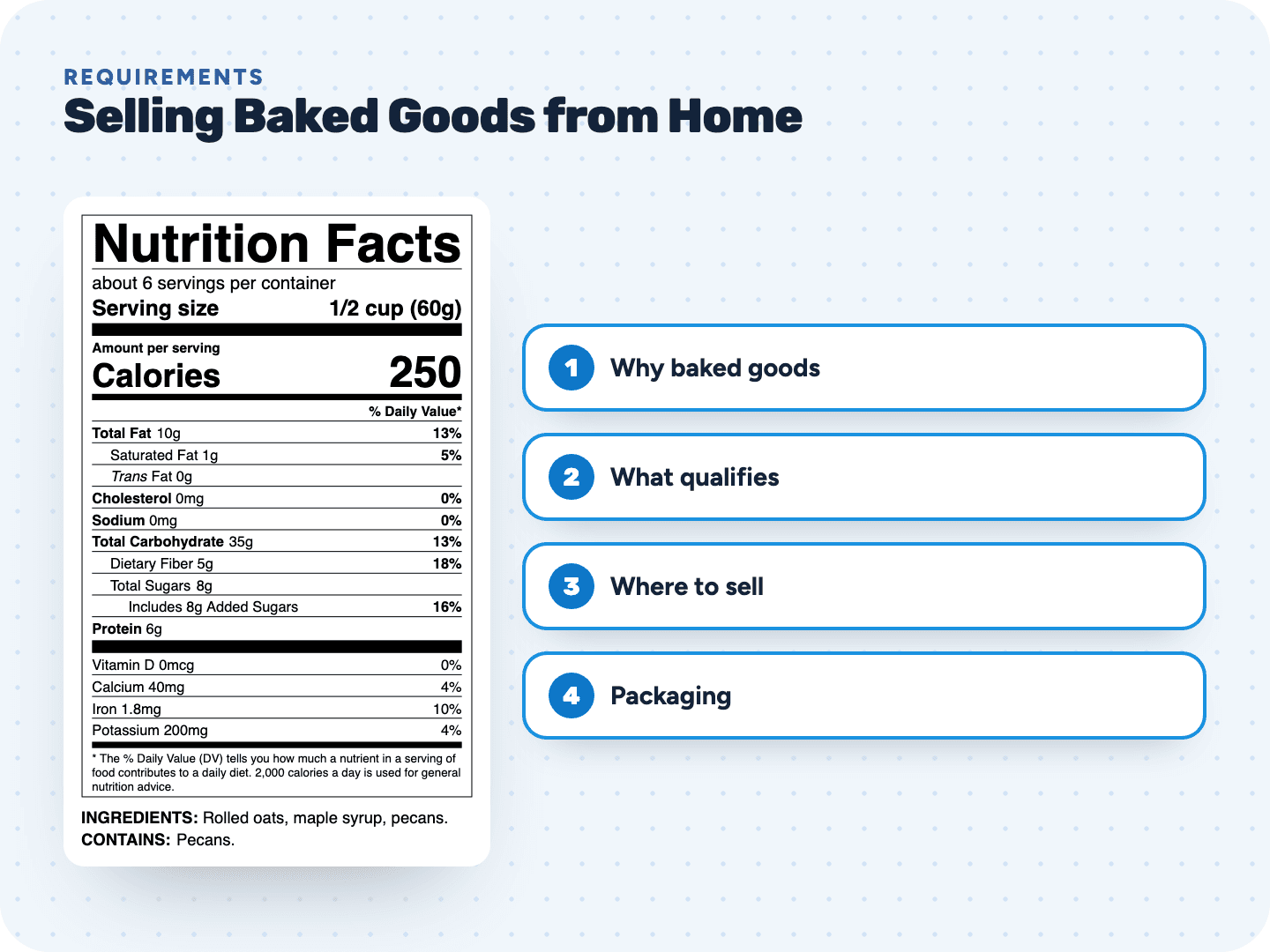
Why baked goods are the easiest food to sell from home
Baking drives off moisture and leaves most cookies, breads and cakes safe on a counter for days. That is exactly what cottage food laws look for. Some states barely allow anything else: Missouri's cottage food list has just three categories, and baked goods are one of them. Wisconsin never passed a broad cottage food law, yet court orders free home bakers from licensing when they sell shelf-stable baked goods straight to consumers.
Wisconsin also shows that baked has a meaning. Its Department of Agriculture describes it like this:
Utah draws the same line: oven or skillet heat counts, frying and steaming don't. So fried doughnuts are not a baked good there, however shelf stable they are.
Which baked goods you can sell from home
Use this table as a first sort, then check every item against your own state's list:
| Baked good | Usually allowed? | What states say |
|---|---|---|
| Cookies, brownies, bars | Yes | Shelf stable in their plain form |
| Yeast bread and rolls | Yes | Utah wants a lab pH of 4.0 or less for sourdough from a homemade starter |
| Banana, zucchini and other quick breads | Often | Maryland asks for a lab test for moist quick breads; Georgia allows produce baked into the batter |
| Fruit pies | Yes | Named on the Ohio, Kentucky and Colorado lists |
| Cream, custard, meringue and pumpkin pies | Usually no | Ohio sends cream, custard and pumpkin pies to a licensed home bakery; Utah excludes custards and pumpkin fillings |
| Cheesecake | Usually no | Excluded in Pennsylvania, Massachusetts and Michigan |
| Cakes with buttercream | Depends | Connecticut accepts shelf-stable buttercream; New Jersey bans buttercream |
| Cream cheese frosting | Usually no | Excluded in Michigan, New Jersey and Connecticut |
| Bread with cheese or meat | Depends | Michigan allows shredded hard cheese mixed into the dough; Oregon excludes focaccia with cheese |
| Fresh fruit on top | Usually no | Missouri and Georgia exclude fresh fruit garnish |
The pattern is easy to remember: the more a bake depends on cream, cheese, eggs or fresh fruit after it leaves the oven, the less likely a cottage food law covers it.
How to sell baked goods from home: where and to whom
Selling from your door, for pick-up or at a market is fine in nearly every state. Cafes and stores are where it changes:
- Ohio: licensed stores and restaurants may sell your labeled baked goods, or use them in the food they serve
- Oregon: a store can carry your products if it displays them apart from other food, with a sign saying they are homemade
- Maine: a Home Food License covers sales at retail stores and at wholesale
- Florida and Connecticut: every sale goes straight to the consumer, so no cafes and no consignment
Markets have one trap for bakers. In Ohio, a table of unwrapped cookies that customers pick themselves needs a temporary or mobile food license, issued locally. Prepackaged and labeled, the same cookies need none.
Selling Baked Goods at a Farmers Market →Selling Baked Goods Online →Packaging baked goods for sale
Packaging keeps your bakes fresh, and in most states it is also where the label goes. A few rules bakers run into:
- Ohio bans reduced oxygen packaging for cottage food, which includes vacuum sealing
- Arizona wants packaging that encloses the food completely with a tamper-evident seal, and your label can be that seal
- New Jersey lets single cupcakes carry one tag with all the required information
- Michigan lets a wedding or specialty cake carry its label information on the invoice delivered with the cake
Pick packaging with room for your label. A cello bag with a fold-over topper or a box with a back sticker both work for cookies and bars; a loaf needs a band or a side label big enough for the ingredient list.
How to price baked goods
Price per item, not per batch. Add up the ingredients for one batch, divide by the number of pieces it yields, then add the bag or box, the label and a fair rate for your time. Market fees and card fees come off the top too. Round to prices that are easy at a market table.
Your price can even change your legal limit. Michigan caps cottage food at $50,000 in yearly gross sales, but lifts the cap to $75,000 for a business whose products are priced at $250 or more apiece. Celebration cakes count.
Labeling baked goods sold from home
Nearly every bake contains wheat, milk or egg, and sesame, peanuts and tree nuts turn up on rolls, cookies and bars. That makes the allergen line the most important part of a baker's label. The home kitchen statement is the second, and its wording is never shared between states: Ohio asks for "This product is home produced.", while Utah wants "Home Produced" on the front panel, bold, at least 12-point.
A few states go lighter on direct sales. Pennsylvania lets you sell bakery items straight to the consumer without a label, provided you can tell a customer the ingredients when asked. Maine needs no label on food you sell directly from your home. Everything you sell through a store still needs one.
Enter your recipe in our tool and the ingredient list builds itself in weight order, with the vitamins in enriched flour and the parts of baking powder in parentheses, plus a Contains line for every major allergen. One recipe, one label, reprinted for every batch.
Cottage Bakery Label →Ingredient Labels for Baked Goods →Start your baked goods label →Growing a home bakery business
A home bakery business grows in steps. First, more products your state allows. Then, in states that permit it, cafes and stores. After that comes the move that every cottage food law forces sooner or later: a licensed kitchen. Wisconsin requires a license once you wholesale baked goods, and Maine moves refrigerated bakes to a commercial license.
A store shelf usually means the full federal label, with Nutrition Facts. Make your labels in our tool from the start, and the same recipe gives you the Nutrition Facts panel when that day comes.
Cottage Bakery License →Baked Goods Labeling Requirements →Selling baked goods from home in your state
Every state page lists the foods allowed, the frostings and fillings that are out, and the label statement word for word.
- Alabama
- Alaska
- Arizona
- Arkansas
- California
- Colorado
- Connecticut
- Delaware
- Florida
- Georgia
- Hawaii
- Idaho
- Illinois
- Indiana
- Iowa
- Kentucky
- Louisiana
- Maine
- Maryland
- Massachusetts
- Michigan
- Minnesota
- Mississippi
- Missouri
- Nebraska
- Nevada
- New Jersey
- New Mexico
- New York
- North Carolina
- Ohio
- Oklahoma
- Oregon
- Pennsylvania
- South Carolina
- South Dakota
- Tennessee
- Texas
- Utah
- Virginia
- Washington
- West Virginia
- Wisconsin