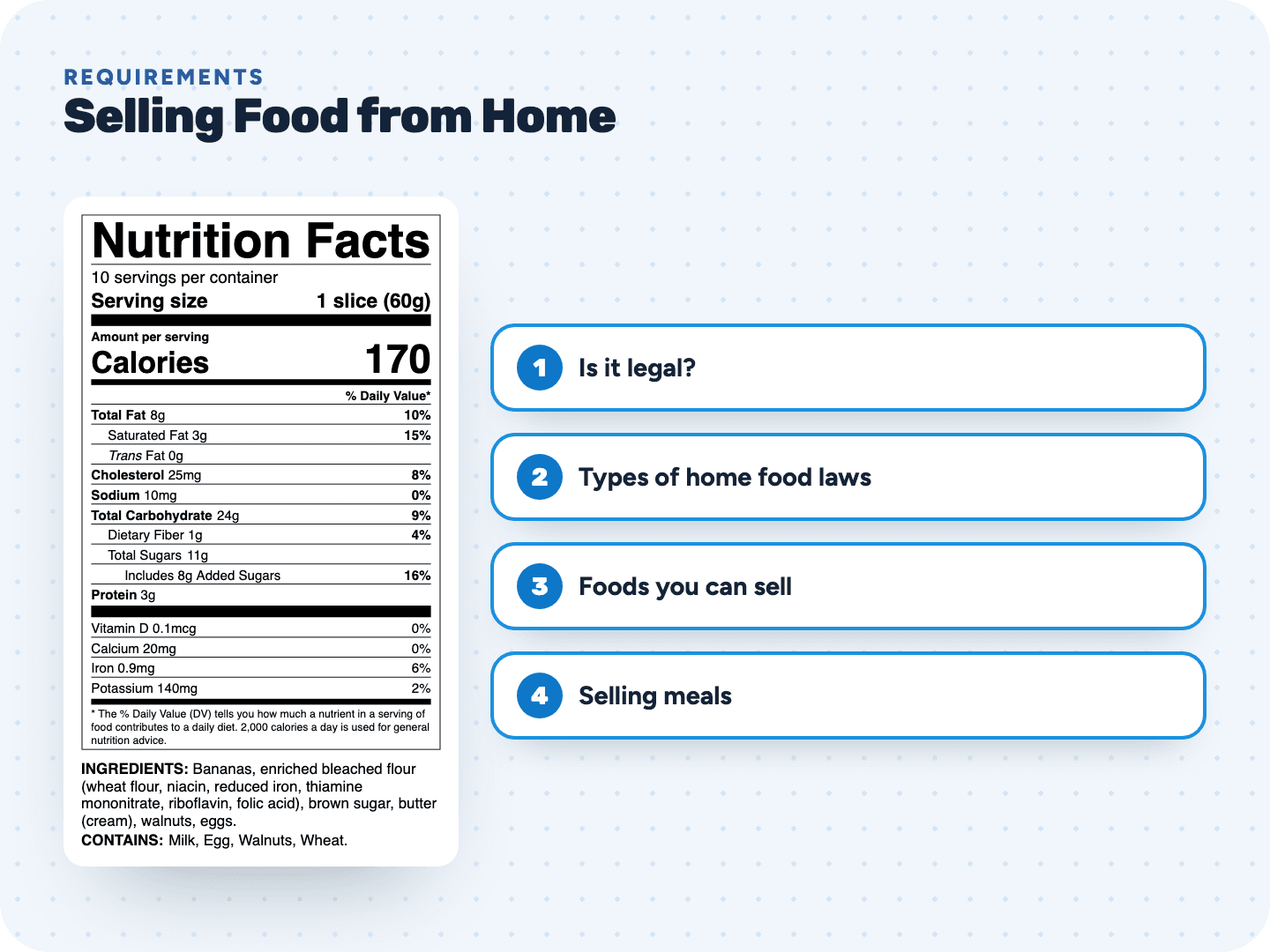
Can you sell food from home?
Yes, in most states, as long as you stay inside the rules of your state's home food law. Those laws are state law, so the answer to almost every practical question comes from your state, not from Washington. At the federal level, FDA's food facility registration rule leaves your house out completely:
That doesn't make home food unregulated. It means your state's rules are the ones that count, and they vary more than most people expect. A cookie you can ship anywhere in your state from Indiana has to be handed over face to face in Mississippi.
The four kinds of home food laws
Home food laws come in roughly four models. Knowing which one your state uses tells you how much paperwork to expect:
| Model | What it means for you | Examples |
|---|---|---|
| Cottage food law, nothing to file | Follow the rules and label correctly; no application | Ohio, Iowa, Missouri, Michigan |
| Cottage food law with registration or permit | Register or apply before your first sale, sometimes with a fee | Arizona (free), Minnesota (free or $50), Connecticut ($50), New Jersey ($100) |
| Food freedom act | Broad exemption from state licensing, often including some perishable foods | Tennessee, Arkansas, Idaho, Oklahoma |
| Licensed or inspected home kitchen | An agency inspects your kitchen before you sell | North Carolina, Pennsylvania, Maine |
The model is not the whole story. Tennessee's Food Freedom Act frees you from state licensing entirely, yet sends refrigerated foods through stricter rules. Minnesota registers everyone, but charges nothing while your sales stay at or under $7,665 a year. A new Minnesota law will replace those tiers with one $30 yearly fee for every producer.
What food can you sell from home?
The safe bet everywhere is food that stays safe without refrigeration: baked goods, candy, jams and jellies, granola, dry mixes, roasted coffee. States then go one of two ways. Some publish a closed list: Missouri allows only three groups: baked goods, jams and jellies in jars, and dried herbs. Others allow nearly everything: Arizona accepts perishable foods too, once you register.
Foods that are off limits in most home food laws:
- Meat, poultry and seafood, as a product or an ingredient
- Low-acid canned foods, like canned green beans or soups
- Dairy products such as cheese and yogurt
- Foods that need refrigeration, unless your state makes room for them
- Pet food and pet treats, which Michigan lists among the foods that are not cottage food
Pickles, salsa and other acidified foods sit in a gray zone. Arkansas allows them with a pH of 4.6 or lower and a batch number on the label. Michigan doesn't allow them as cottage food at all.
Selling cooked meals from home
Plates of food are the hardest thing to sell from a home kitchen. Most cottage food laws cover packaged, shelf-stable products, not dinners. Idaho's Direct-to-Consumer Commerce Act, one of the broadest laws, still leaves out food that is cooked or served on the spot to be eaten right away.
Utah built a route for meals: a microenterprise home kitchen permit, handed out by local health departments. Expect an inspection within the week before opening, written procedures, a yearly renewal and food that goes straight to the consumer. Arizona's cottage food program also takes perishable food, with a strict delivery rule: one destination, within two hours.
How to sell food from home: in person, online, shipping, stores
Selling face to face is allowed almost everywhere. Online orders, shipping and store sales are where states split. Six examples:
| State | Online orders | Shipping | Stores and cafes |
|---|---|---|---|
| Mississippi | Ads only; the sale is in person | No | No |
| Nevada | Face-to-face sales only | No | No |
| Indiana | Yes | Yes, to buyers in Indiana | No, not for resale |
| Georgia | Yes | Yes, mail order | Yes, unless your city or county opts out |
| Tennessee | Yes, shelf-stable foods | By carrier inside Tennessee | Grocery stores, shelf-stable foods |
| Hawaii | Yes | Yes, by mail or shipping | Yes, with a written homemade disclosure |
State lines are the hard stop. Idaho, Tennessee and Utah all keep home food sales inside the state, and a sale into another state brings in FDA and that state's rules. If out-of-state customers are your plan, you are planning a licensed food business.
How much can you earn selling food from home?
Some states cap your yearly sales and some don't. The caps count gross sales, the money that comes in before costs, so keep a running total:
| State | Yearly sales cap |
|---|---|
| Mississippi | $35,000 |
| Minnesota | $78,000 |
| Maryland | $100,000 |
| Oklahoma | $250,000 |
| Alabama, Georgia, Ohio, Tennessee | No cap |
There is a federal number to know as well. A small seller is exempt from Nutrition Facts, as long as the label and advertising carry no nutrition claims:
How to start a food business from home
Setting up a cottage food business is mostly reading and paperwork. Work through it in this order:
Two questions people forget to ask: who may help, and where may you cook? Nevada's law is for a single person in their own home, with no partners or employees. Arizona lets an unregistered helper cook under your direct supervision. Michigan accepts a rented house or apartment, as long as it is your primary residence.
The label every home food business needs
Almost every home food law ends with a label. The core items repeat from state to state: the food's name, your name and address (or a state ID number where allowed), the ingredients by weight, the major allergens and often the net weight. Then comes a statement in your state's exact words, for example:
Our tool does the slow part. Enter your recipe in cups and spoons, confirm the USDA match for each ingredient, and you get the ingredient list in the right order with sub-ingredients and a Contains line. Add your state's statement on the free template, or add Nutrition Facts if a store or a customer asks for them.
Cottage Food Label Requirements →Cottage Food Label Maker →Try it free with your recipe →When your home food business outgrows the kitchen
Passing the sales cap, landing a store account in a state that doesn't allow it, or shipping out of state all lead to the same place: a licensed kitchen, either your own, a rented commercial kitchen or a co-packer. The home kitchen statement comes off the label and the federal rules apply in full, usually with Nutrition Facts.
License to Sell Food →Co-Packer →Selling food from home: the law in your state
Pick your state for the full picture: the foods allowed, registration, training, the sales cap, online sales and the exact label statement.
- Alabama
- Alaska
- Arizona
- Arkansas
- California
- Colorado
- Connecticut
- Delaware
- Florida
- Georgia
- Hawaii
- Idaho
- Illinois
- Indiana
- Iowa
- Kentucky
- Louisiana
- Maine
- Maryland
- Massachusetts
- Michigan
- Minnesota
- Mississippi
- Missouri
- Nebraska
- Nevada
- New Jersey
- New Mexico
- New York
- North Carolina
- Ohio
- Oklahoma
- Oregon
- Pennsylvania
- South Carolina
- South Dakota
- Tennessee
- Texas
- Utah
- Virginia
- Washington
- West Virginia
- Wisconsin