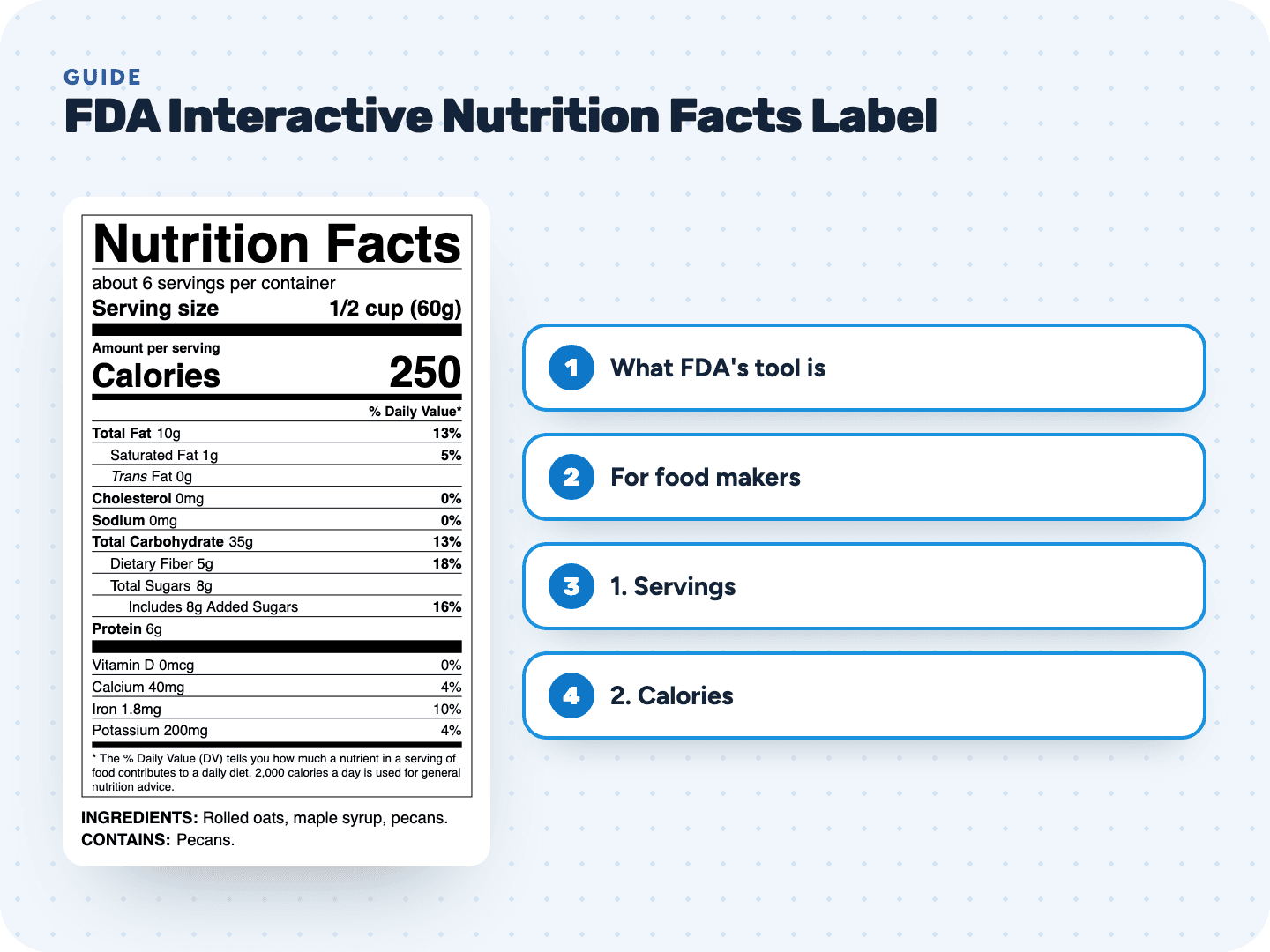
What FDA's Interactive Nutrition Facts Label is
FDA runs the Interactive Nutrition Facts Label on accessdata.fda.gov and links to it from its Nutrition Facts Label education page on fda.gov. You click a part of a sample label and get a plain explanation. It's free, with no sign-up.
- What's on the Label: overview, serving size, servings per container, calories, nutrients and % Daily Value
- A section on reading the ingredient list
- A glossary of label terms
- Fact sheets and resources
- A short fun facts quiz
- A Spanish version, linked as Español
What it explains, and what it leaves to you
FDA built the tool for shoppers learning to read the label. If you sell food, it tells you what each part means, not how to work out your own numbers. Rounding, serving size math and % Daily Value calculations aren't in it.
So the tour below has two halves for every part: what FDA's tool tells a shopper, and what the maker had to do to print that number. Our example is a trail mix of raisins, almonds, roasted peanuts, chocolate chips and sunflower seeds, sold in an 8 oz (227 g) bag.
Part 1: serving size and servings per container
What a shopper learns: every number below is for one serving, and the serving size is what people typically eat at once, not a recommendation.
What the maker did: looked up the FDA reference amount for nuts, seeds and mixtures, which is 30 g, and wrote it as a household measure: 3 tbsp (30g). Then an 8 oz bag is 227 g, and 227 g ÷ 30 g = 7.6 servings. Above 5, servings round to the nearest whole number, with "about" when the result isn't exact: about 8.
Part 2: calories
What a shopper learns: how much energy one serving gives, against the 2,000 calories a day used for general nutrition advice.
What the maker did: added up the calories of every ingredient in one 30 g serving: 149.5. Above 50 calories, the label rounds to the nearest 10, so it prints 150 in large, bold type.
Part 3: the nutrients
What a shopper learns: which nutrients to get less of (saturated fat, sodium, added sugars) and which to get more of (dietary fiber, vitamin D, calcium, iron, potassium).
What the maker did: totaled each nutrient from the ingredients, then rounded each one by its own rule:
| Nutrient | Exact | On the label | Rule |
|---|---|---|---|
| Total fat | 10.48 g | 10g | 5 g or more: nearest gram |
| Saturated fat | 1.79 g | 2g | Under 5 g: nearest 0.5 g |
| Sodium | 42.5 mg | 45mg | 5 to 140 mg: nearest 5 mg |
| Total sugars | 7.97 g | 8g | Nearest gram |
| Added sugars | 2.40 g | 2g | Nearest gram |
| Protein | 4.51 g | 5g | Nearest gram |
Most of the sugar comes from the raisins, so it counts toward total sugars only. The 2 g of added sugars is the sugar inside the chocolate chips.
Every rounding rule in one table →Part 4: % Daily Value
What a shopper learns: FDA's quick guide. 5% DV or less per serving is low; 20% DV or more is high. Our trail mix is low in sodium (2%) and added sugars (4%).
What the maker did: divided each amount by its Daily Value. Total fat: 10 g ÷ 78 g = 12.8%, printed as 13%. Saturated fat: 2 g ÷ 20 g = 10%. Total sugars get no percentage, because FDA has set no Daily Value for them.
FDA Daily Values →Part 5: vitamins and minerals
What a shopper learns: four are required: vitamin D, calcium, iron and potassium, each as an amount and a percentage.
What the maker did: rounded the amounts and used larger steps for the percentages: 2% steps up to 10%, then 5% steps up to 50%, then 10% steps. The trail mix has no vitamin D, so it shows 0mcg and 0%. Iron is 0.8 mg, which is 4.4% of 18 mg, printed as 4%.
Part 6: the footnote
What a shopper learns: what % Daily Value means. The footnote reads: *The % Daily Value tells you how much a nutrient in a serving of food contributes to a daily diet. 2,000 calories a day is used for general nutrition advice.
What the maker did: copied it word for word, under a bar below the vitamins and minerals. Small packages that use the small-package tabular or linear format may leave it off or shorten it to "% DV = % Daily Value".
From the tour to your own label
FDA's tool teaches you to read a label. Our label maker builds yours, using the same rules you just saw:
- Type your recipe in cups, spoons, ounces or grams
- Confirm each ingredient's match to USDA FoodData Central data
- Pick your serving size from the FDA reference amounts
- Get calories, nutrients and % Daily Values, rounded by FDA rules, free to preview
- Download the label, plus a calculation report that shows the rule behind every number