Start with your state's honey rules
Honey often has its own place in state law, separate from the cottage food rules. Two examples show how different that looks:
| State | What a small beekeeper gets | Where the limit is |
|---|---|---|
| Virginia | A home kitchen exemption for honey your bees made: no permit, no inspection, no inspection fees | Less than 250 gallons a year, a required label statement, and no other home foods beyond the ones the law allows |
| Connecticut | No license up to $25,000 a year in gross revenue from honey or maple syrup | Above $25,000: a yearly license from the Department of Agriculture, $50 non-refundable |
That Virginia statement goes on every jar sold under the home exemption. Other states have their own caps, honey house rules and label lines. Our state honey pages cover them one by one:
Alabama Honey Label Requirements →Connecticut Honey Label Requirements →Illinois Honey Label Requirements →Indiana Honey Label Requirements →Kentucky Honey Label Requirements →Maine Honey Label Requirements →Missouri Honey Label Requirements →NC Honey Label Requirements →NJ Honey Label Requirements →SC Honey Label Requirements →Virginia Honey Label Requirements →WV Honey Label Requirements →What goes on a jar of honey
- The name: "honey". Add a plant, as in "Orange blossom honey", only when the bees mostly worked that plant
- The net weight, because honey is sold by weight: Net Wt 12 oz (340 g)
- Your name and address, or the packer's or distributor's with the right qualifying phrase
- Your state's honey or home kitchen statement, if it has one
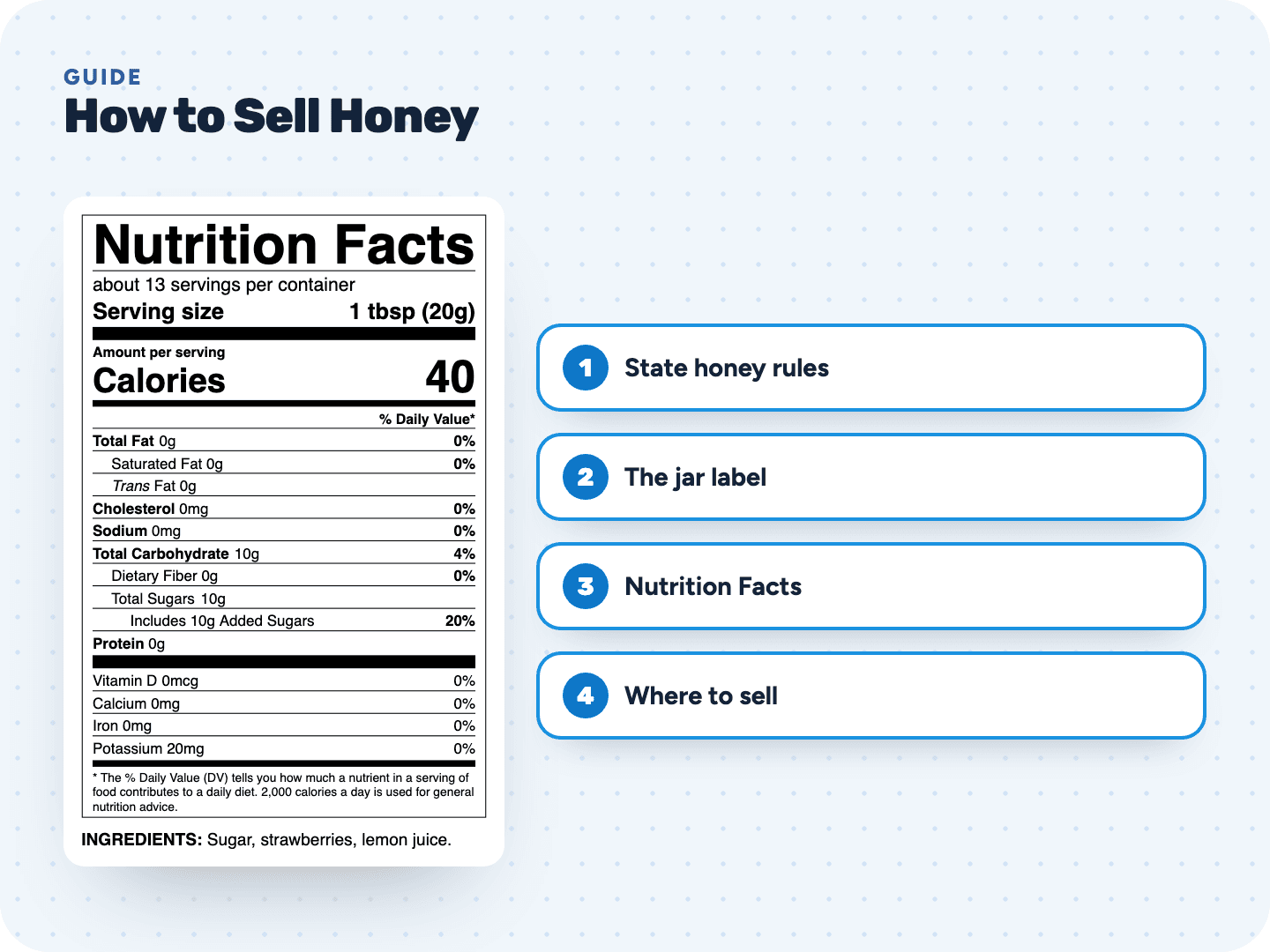
- Nutrition Facts, unless you qualify for an exemption (see below)
Pure honey needs no ingredient list: it is a single ingredient, and its name says it all. That changes the moment you add something. Cinnamon, chili or lavender honey is no longer just "honey". It gets a descriptive name and a full ingredient list, and many states treat it as a cottage food with its own rules.
Honey Labeling Requirements (FDA) →Custom Honey Label →Hot Honey Label →Does a jar of honey need Nutrition Facts?
Not always. The federal small business exemption fits a seller who deals straight with consumers and stays at or under $500,000 a year in total sales to consumers, or at or under $50,000 a year in food sales to consumers. A beekeeper selling jars at a farm stand or market often fits.
Two things end it. A nutrition claim or nutrition information on the jar, on a sign or in your ads, like "rich in antioxidants" or "only 60 calories a spoon". And selling through a shop: there, the shop sells to the consumer, so the exemption you lean on becomes the low-volume one for small manufacturers.
When you do need the panel, the serving is 1 tablespoon. Pure honey also has a special added sugars rule: the "Includes Xg Added Sugars" line may be left out, with the % Daily Value followed by a † footnote. Our tool handles the serving size and the rounding and prints the standard added sugars line, which is also correct for honey; the honey nutrition label page walks through the † option.
Honey Nutritional Information Label →Do I Need a Nutrition Label? →Where to sell honey
| Where | What to check |
|---|---|
| Farm stand or your home | Your state's honey rules and any local zoning for a home business |
| Farmers markets | The market's own vendor rules and whether a permit is needed |
| Local shops and cafes | Whether your state exemption allows sales to stores, and Nutrition Facts |
| Your own website | Your state's rules for mail order, and federal rules for buyers in other states |
| Amazon | Amazon's food policy, a date on every jar, and a full label with Nutrition Facts |
Selling honey online and on Amazon
Online sales inside your state follow your state's rules. A jar shipped to another state is food in interstate commerce, which FDA regulates, so the full federal label applies there.
Amazon adds its own layer. Its food policy wants every jar completely labeled, right down to an expiration date and nutrition facts. Amazon's list of products that may skip the expiration date names items like vinegar, solid sugar and salt, but not honey, so plan a best-by date on every jar.
Food Date Labeling →That line is on Amazon's list of products it won't sell. Regular honey is fine.
Selling Food on Amazon →